
8 Drawing Tips to improve your drawing skill
Professional Drawing Tips
1. Understanding drawing fundamentals
Drawing fundamentals are the formative principles and elements that make up a successful composition. While these may differ across various art disciplines, they generally serve the same purpose.
- Principles of Art: Balance, Contrast, Proximity, Emphasis, Rhythm, and Unity.
- Contrast and Emphasis: These play a major role in developing interesting and dynamic compositions. Using contrasting values or gradations where needed can instantly elevate your artwork. "Emphasis" refers to making a specific portion of your work dominant so it stands out; this is a technique widely used in animation, photography, and graphic design.
How does this make a difference? By applying these elements intentionally, you can make better decisions regarding your concept. For instance, capturing your viewer’s eye may depend on your use of negative space, color saturation, or the contrast of textures across your composition.

2. Master Proportions
A common issue I see with beginning artists is a lack of understanding regarding proportions, which can negatively impact any composition. Incorrect proportions are often the reason a drawing looks "unprofessional."
- Simplify: Start by breaking your subject down into simple geometric shapes. This allows you to understand the basic structure before adding details. [link removed].
- Study Anatomy: If you are drawing portraits or figures, learning muscle formation will drastically improve your work.
- The Camera Trick: To test if your drawing is distorted, take a photo of your work-in-progress with your phone. Hold the camera as close to a 90-degree angle as possible. Looking at your work through a screen helps you "step back" and view the overall composition objectively. If you don't have a phone handy, place your artwork far away and look at it from a distance; mistakes will be much easier to spot and correct.
A note on feedback: When you are tired, take a break. Refreshing your eyes will help you spot errors you previously missed. You can also ask friends or fellow artists for feedback—just remember to take criticism constructively and use it as a tool to improve.

Need more in-depth guidance on proportions? Read my Drawing with Proportions article! This will get you all set with drawing accurately.
3. Choosing correct shading techniques
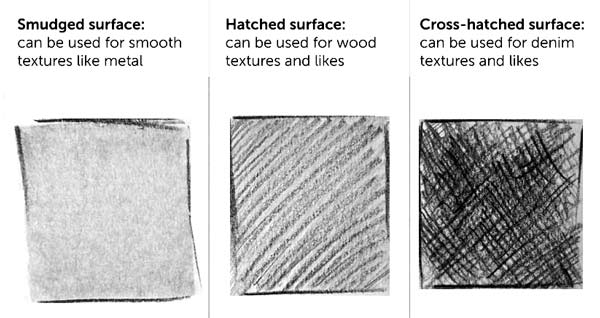
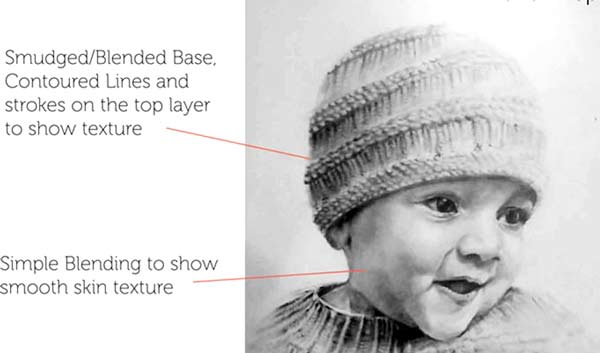
There is no "right" or "wrong" here, but selecting a shading technique that fits your style will make a positive impact. Experiment until you find what works for you.
- Smooth Textures (e.g., Silk): Blending is best. You can use a stump or a cotton swab to achieve a soft, seamless look.
- Structured Textures (e.g., Denim): Contouring and hatching are often more effective.
- Combination: To get the best output, you may need to combine techniques. After practicing a few times, you will instinctively know which approach suits the texture you are drawing.
4. Improving your drawing strokes
Beginners often draw with thick, uniform lines without varying their intensity. By varying your stroke thickness, your work will instantly appear more dynamic.
The "Wrist vs. Shoulder" Habit: Since childhood, we are taught to write using our wrist, which limits our control and range of motion. If you use your shoulder instead, you can draw bigger, softer lines and control your pencil pressure more effectively.
- Practice: Take a piece of paper and draw large circles or long, sweeping lines. Focus on moving your entire arm from the shoulder, not just the wrist. Practice this for a few minutes daily to break old habits.


5. Mannequinization (simplify into geometric shapes)
Have you noticed how artists' mannequins are made up of cylindrical and spherical blocks? That is exactly what Mannequinization is: simplifying your subject into easy geometric shapes.
This makes shading and lighting much easier because evaluating tonal values (highlights, shadows, and midtones) on simple shapes is less complex than on a detailed human form. It is an essential concept for figure drawing, as it helps you build volume and remember joint placement much faster than relying on gesture lines alone. You can also use this for still-life drawings!
6. Perspective
This is vital for those interested in still life, cityscapes, or landscapes. Without proper perspective, even a simple building can look distorted, regardless of how straight your lines are.
- The Basics: Learn the concepts of the horizon line and vanishing points. Start with 1-point perspective, then move on to 2-point and 3-point perspective as you grow.
- Different Views: Familiarize yourself with bird's-eye views, insect's-eye views, isometric views, and orthographic views. These are vital for implementing perspective correctly.
7. Dividing composition into portions
Large or complex drawings can become tedious, often leading to impatience and frustration. When we rush to "get it done," the work ends up looking unpolished.
The best way to handle large pieces is to divide them into portions. Most compositions have at least two main elements: the subject and the background (often with a foreground). Tackle one element at a time. There is no rule for which to draw first—I usually draw the background, then the subject, and finally the foreground. Working in manageable chunks helps you maintain quality throughout the entire composition.
8. Be patient and keep practising
This is the king of all tips: keep calm and keep creating. Drawing is not a race; take your time and practice every day. If you draw hastily, you will make small mistakes that reduce the overall quality of your work. Drawing slowly allows you to follow a rhythm and pay constant attention to your composition.
Be positive, work toward your goal, and always be proud of your progress.
Dream Big! Dream the Impossible! Someday, it will become possible.